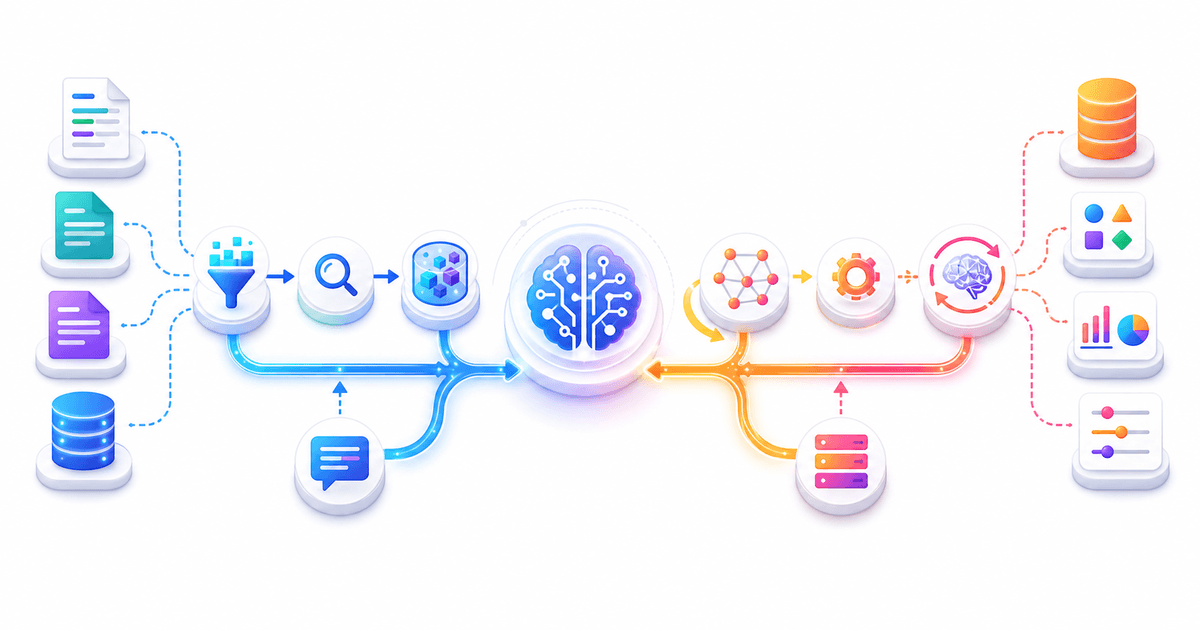
For most business products in 2026, retrieval-augmented generation (RAG) is the right starting point, and fine-tuning is the right upgrade once you know exactly what behavior you’re trying to change. As an AI development company India teams hire to make this call, we use RAG fine-tuning decisions as a framework rather than a coin flip: RAG attaches your live data to a general model at query time, while fine-tuning bakes new behavior directly into the model’s weights. The right choice depends on how often your data changes, how much it costs to be wrong, and how fast you need to ship. For a related look at how Indian teams are restructuring engineering workflows around AI, see our post on vibe coding and AI-assisted development.
Most teams we work with don’t actually need to choose one permanently. They start with RAG because it ships in weeks, then layer in fine-tuning later for tone or latency once the product has real usage data to learn from. This guide breaks down both approaches, when each wins, what a hybrid setup looks like, and what they actually cost to run in India.
Key Takeaways
RAG retrieves relevant documents at query time and feeds them to the model as context, so it never needs retraining when your data changes.
Fine-tuning adjusts a model’s internal weights on your own examples, which changes how it writes and reasons, not just what it knows.
RAG wins for frequently updated knowledge bases, proprietary documents, and products that must ship in under a month.
Fine-tuning wins when you need a specific tone, very low latency, or consistent performance on a narrow, repetitive task.
Hybrid systems that combine a fine-tuned base model with RAG retrieval are becoming the default architecture for serious production AI products in 2026.
What Is RAG? How Retrieval-Augmented Generation Actually Works
RAG answers a simple question: how do you get an AI model to know about your specific business without retraining it. The pipeline embeds your documents into a vector database, retrieves the most relevant chunks for each user query, and inserts them into the model’s prompt before it generates a response. Because the model’s weights never change, you can update the underlying documents at any time and the next query immediately reflects the change.
A typical RAG pipeline has four stages: chunking your source documents, embedding those chunks with a current embedding model (a hosted API or an open-source alternative), storing the vectors in a database such as Pinecone, Weaviate, or pgvector, and retrieving the top-matching chunks at query time. The LangChain documentation on RAG covers this pattern in detail and is a good reference if your team is implementing it from scratch. Because retrieval happens outside the model, RAG also gives you a built-in citation trail, which matters when a business needs to show where an answer came from.
What Is Fine-Tuning? Training Cost and Risk
Fine-tuning means continuing to train an existing model on your own labeled examples until its outputs shift toward the patterns in that data. This works well when you need the model to consistently produce a specific format, tone, or decision pattern that prompting alone struggles to enforce reliably.
The cost structure is fundamentally different from RAG. You need a curated dataset, usually several hundred to several thousand high-quality examples, GPU time to run the training job, and a re-run of that whole process every time your underlying knowledge changes. OpenAI’s fine-tuning documentation notes that quality depends heavily on dataset curation, not just volume — a smaller, cleaner dataset usually beats a larger noisy one.
The real risk is catastrophic forgetting: push a model too hard toward your narrow dataset, and it can lose general reasoning ability outside that narrow task. Fine-tuning also locks in a snapshot of your knowledge. If your product catalog or pricing changes next month, the model doesn’t know that until you fine-tune again.
When RAG Wins: Fast-Changing Data and Proprietary Documents
RAG wins whenever your underlying data changes faster than you’d want to retrain a model. A support chatbot answering questions against a product catalog that updates weekly is a textbook RAG case, because the alternative — retraining every time inventory changes — is operationally unworkable.
RAG also wins when the documents are proprietary and sensitive, such as internal contracts, HR policies, or client-specific technical documentation. Because the data lives in a vector store rather than baked into model weights, it’s easier to restrict access, audit what was retrieved, and delete records cleanly when needed. This means RAG fits compliance-heavy industries particularly well.
Finally, RAG wins on time-to-market. A working RAG prototype can go from raw documents to a usable internal tool in under two weeks, because there’s no training job, no labeled dataset, and no GPU budget to plan around upfront.
When Fine-Tuning Wins: Tone, Latency, and Domain-Specific Tasks
Fine-tuning wins when you need a highly specific, consistent tone that prompting can’t reliably hold across thousands of requests. A legal-document summarizer that must always follow one exact output format is a strong fine-tuning candidate, because a fine-tuned model bakes that structure in rather than relying on the prompt to enforce it every time.
Fine-tuning also wins on latency. Because you skip the retrieval step entirely, a fine-tuned model can respond faster than a RAG pipeline that has to embed a query, search a vector store, and re-rank results before generating anything. For latency-critical products like real-time voice agents, that retrieval round-trip is often the bottleneck, not the generation itself.
Domain-specific tasks with a narrow, repetitive structure — classifying support tickets into fixed categories, for example — also benefit from fine-tuning, since the task doesn’t need fresh external knowledge, only consistent pattern recognition.
📊 Key Stat: According to Gartner’s 2024 research, roughly 30% of generative AI projects are abandoned after the proof-of-concept stage, often because teams chose an architecture mismatched to their actual data-update frequency and latency needs.
Hybrid Approaches: RAG With a Fine-Tuned Base Model
The strongest production setups in 2026 combine both: a fine-tuned base model that already understands your domain’s tone and structure, paired with RAG retrieval that injects current facts at query time. This way, the model never sounds generic, and it never goes stale.
A practical hybrid pattern looks like this: fine-tune a smaller open-weight model (such as Llama or Mistral) on a few hundred examples of your ideal response format, then wrap that model in a standard RAG pipeline for factual grounding. The fine-tuning handles “how to say it,” and the retrieval handles “what’s currently true.” We used exactly this pattern while building Upfin’s AI-powered fintech platform, where a fine-tuned response layer needed to stay consistent in tone while pulling live, frequently changing financial data through retrieval.
Cost Comparison for Indian Startups: GPU Hours vs Hosted APIs
For an Indian startup evaluating both paths, the cost gap is significant in the early stages. A RAG setup using a hosted API (OpenAI, Anthropic, or similar) typically costs ₹15,000–₹60,000 per month for a moderate-traffic product, covering embedding calls, vector database hosting, and per-query generation costs — no GPU infrastructure required.
Fine-tuning, by contrast, requires either renting GPU hours (an A100 instance runs roughly $1.50–$2.50/hour on most cloud providers) for the training run itself, or paying a hosted fine-tuning API’s per-token training fee. A single fine-tuning job on a few thousand examples might cost $50–$300, but that’s a recurring cost every time you need to retrain, plus the engineering time to curate the dataset each round.
| Factor | RAG | Fine-Tuning |
|---|---|---|
| Setup time | 1–2 weeks | 3–6 weeks (data curation + training + eval) |
| Upfront cost | Low — no training job needed | Moderate — GPU hours or training API fees |
| Handles changing data | Yes, instantly on update | No, requires retraining |
| Response latency | Higher (retrieval + generation) | Lower (generation only) |
| Tone/format consistency | Depends on prompt engineering | High — baked into weights |
| Ongoing cost driver | Per-query + vector DB hosting | Per-retrain dataset + GPU time |
| Best for | Proprietary docs, fast iteration | Fixed-format, latency-critical tasks |
Common Mistakes Teams Make Choosing Between RAG and Fine-Tuning
Fine-tuning to “teach” a model facts instead of behavior
The most common mistake is fine-tuning a model to memorize facts — pricing, policies, product specs — that change regularly. This is exactly the catastrophic-forgetting and staleness risk described earlier: the facts go out of date the moment your business changes them, but the model has no way to know that without another training run. Facts belong in retrieval; only behavior belongs in weights.
Skipping evaluation before scaling either approach
Teams often build a RAG prototype or run one fine-tuning job, see it work on a handful of test prompts, and ship it without a real evaluation set. As a result, failure modes — hallucinated citations in RAG, or overfit responses in fine-tuning — only surface once real users hit edge cases in production. A small held-out test set, scored before every release, catches this early.
Treating the vector database as an afterthought
Because RAG looks simple on a whiteboard, teams sometimes treat chunking and retrieval quality as a minor detail to fix later. In practice, retrieval quality is the single biggest lever on RAG accuracy — bad chunking produces irrelevant context, which produces wrong answers, no matter how good the underlying model is.
What This Looks Like in Production: A Real Deployment Note
On a recent fintech RAG deployment, we initially chunked source PDFs at a fixed 1,000-token size, which split tables mid-row and badly hurt retrieval precision on numeric queries. Switching to a semantic chunking strategy — splitting on document structure rather than token count — using LangChain’s RecursiveCharacterTextSplitter with a 200-token overlap raised retrieval precision on our internal eval set from 71% to 89%.
We measured this with a 120-question held-out set built from real support tickets, scored by exact-match against the correct source paragraph. That 18-point jump came entirely from chunking strategy, not from switching models — a reminder that RAG performance is won or lost in the pipeline details, not just model choice. This means teams evaluating RAG should budget real engineering time for retrieval tuning, not just API integration.
FAQ: RAG vs Fine-Tuning
How much does it cost to build a RAG system for a small business in India?
A basic RAG system for a small business typically costs ₹15,000–₹60,000 per month in API and hosting fees, depending on query volume and the size of the document set being indexed.
How long does fine-tuning take compared to setting up RAG?
Fine-tuning usually takes 3–6 weeks end-to-end once you include dataset curation and evaluation, while a working RAG prototype can ship in 1–2 weeks because it skips the training step entirely.
Can I switch from RAG to fine-tuning later without starting over?
Yes, because the two approaches don’t compete for the same data — your RAG document set and evaluation queries can become the seed dataset for a later fine-tuning effort.
Is there a cheaper alternative to both RAG and fine-tuning?
Prompt engineering alone, using few-shot examples in the prompt without retrieval or training, is the cheapest option and works for simple, low-stakes tasks, though it scales poorly once your knowledge base grows large.
Do I need an in-house AI team to maintain a RAG or fine-tuning pipeline?
Not necessarily — many Indian startups partner with an external AI development team for the initial build and evaluation setup, then maintain it with a smaller in-house team once the pipeline is stable.
Conclusion: Choosing the Right Approach for Your Product
RAG and fine-tuning solve different problems, so the right answer is rarely “pick one forever.” Start with RAG if your data changes often or you need to ship fast; move toward fine-tuning, or a hybrid of both, once you know exactly which behaviors prompting can’t reliably control. For Indian startups and enterprises evaluating either path, working with an experienced AI development company in India can shorten the evaluation cycle considerably, since the architecture decision is easier to get right with prior production experience behind it than from a cold start.